
Contact Us:

670 Lafayette Ave, Brooklyn,
NY 11216

+1 800 966 4564
+1 800 9667 4558

ORGANIZATIONAL AND MARKET DYNAMICS
About Course

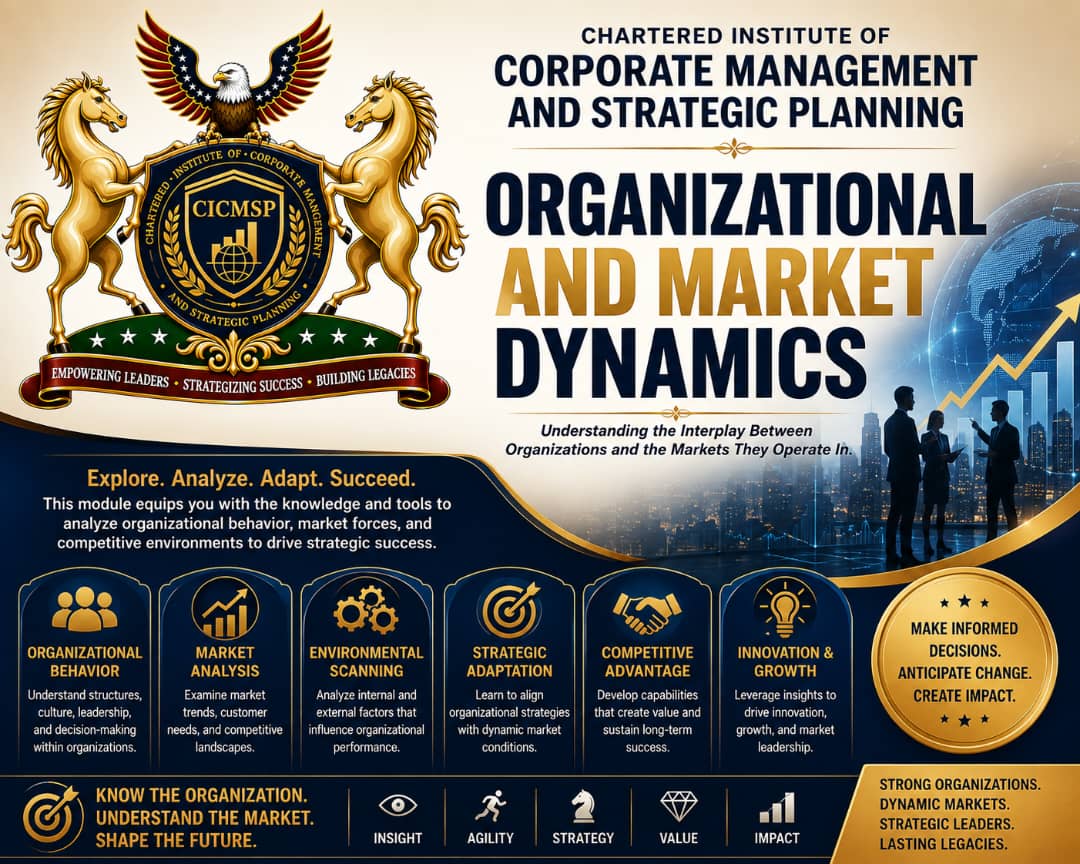
The Postgraduate Diploma (PGD) in Corporate Management and Strategic Planning offered by the Chartered Institute of Corporate Management and Strategic Planning (CICMSP) is designed to develop practitioners and future executives with the analytical, behavioural, and technical competencies required to manage complex organizations and formulate sound corporate strategy in dynamic market environments. The Organizational and Market Dynamics theme situates the learner within the internal (organizational) and external (market) forces that shape corporate decision-making, and equips learners to translate behavioural, marketing, and analytical insight into strategic action.

This theme comprises three interrelated modules: Organizational Behaviour and Human Resource Management, Marketing Management, and Business Statistics and Analytics. Together, these modules build the foundational competencies of managing people, understanding and serving markets, and making evidence-based decisions — all of which are prerequisites for effective strategic planning covered in subsequent themes of the programme.

Show More

What Will You Learn?

  • By the end of this course, learners will be able to:
  • Understand the key organizational, behavioural, and market forces that influence corporate performance and strategic decision-making.
  • Apply principles of Organizational Behaviour and Human Resource Management to manage people, teams, leadership, motivation, and workplace relationships effectively.
  • Analyse organizational structures, cultures, power dynamics, and change processes and their implications for corporate effectiveness.
  • Apply Marketing Management principles to understand customer needs, market segmentation, targeting, positioning, branding, and competitive dynamics.
  • Evaluate marketing strategies and their contribution to organizational growth, customer value, and sustainable competitive advantage.
  • Use Business Statistics and Analytics to collect, organize, analyse, and interpret business data for informed decision-making.

Course Content

CICMSP-PGD-OMD 101: Organizational Behaviour and Human Resource Management
This module provides a comprehensive academic and applied grounding in organizational behaviour (OB) and human resource management (HRM), examining how individual, group, and organizational-level factors shape performance, and how HR systems can be strategically designed to build sustainable competitive advantage. Learners will critically engage with established behavioural theories and contemporary HRM practice, with emphasis on aligning people management with corporate strategy.

  • 1.1: Foundations of Organizational Behaviour
  • 1.2: Individual Behaviour: Personality, Perception, Attitudes and Values
  • 1.3: Motivation Theories
  • 1.4: Group Behaviour and Team Dynamics
  • 1.5: Leadership Theories and Styles
  • 1.6: Organizational Culture and Change Management
  • 1.7: HR Planning and Job Analysis
  • 1.8: Recruitment and Selection
  • 1.9: Performance Management Systems
  • 1.10: Training and Development
  • 1.11: Succession Planning and Talent Management
  • 1.12: Strategic Human Resource Management
  • Applied Case Study

CICMSP-PGD-OMD 102: Marketing Management
This module develops learners' capacity to understand markets and consumers, and to design, implement, and evaluate marketing strategies that create and sustain competitive advantage. Emphasis is placed on integrating marketing decisions with the organization's broader corporate and strategic planning processes, ensuring that marketing strategy is not developed in isolation but as an integral driver of corporate value creation.

CICMSP-PGD-OMD 103: Business Statistics and Analytics
This module equips learners with the statistical reasoning and analytical tools necessary to support evidence-based corporate decision-making and strategic planning. The module progresses from foundational descriptive statistics through inferential techniques to forecasting and introductory business intelligence (BI) tools, with consistent emphasis on the application of these techniques to real corporate management and strategic planning problems.